Tuesday, July 21, 2026


More than one-third of NC jails have exceeded capacity this year


By Rachel Crumpler

Key takeaways: 

  • More than one-third of North Carolina jails have exceeded capacity at some point in 2026, with 19 operating above capacity every month this year.
  • Sheriffs and jail administrators cite stricter pretrial release rules, prison transfer delays, slow-moving courts and gaps in behavioral health care as drivers of the increase.

In North Carolina’s largest jail, hundreds of people sleep on the floor on portable bed platforms. 

As of July 16, 2,146 people were in custody in Mecklenburg County’s uptown Charlotte jail — 242 people above the jail’s capacity of 1,904. Pods designed for 53 people now routinely hold as many as 84, Sheriff Garry McFadden told NC Health News.

Mecklenburg isn’t alone. As sheriffs and jail administrators across North Carolina monitor their daily population counts, many are confronting a similar problem: jails that are near or beyond capacity. 

State data show that at least 36 jails — more than one-third statewide — have operated above capacity at some point so far in 2026, according to a NC Health News analysis of a July 14 confinement report showing the average monthly population in each county jail. Another 17 have come close, reaching at least 90 percent of capacity.

Statewide, the average monthly jail population reached at least 22,543 people in April, the highest monthly average since at least January 2024, according to NC Health News’ analysis of data.

Sheriffs and jail administrators attribute the rising jail populations to many factors, including North Carolina’s population growth, gaps in community mental health and substance use treatment resources that can land people in jail, and slow-moving court cases that can keep people in jail longer. They also point to Iryna’s Law, which took effect in December and limits the use of pretrial release for certain defendants, as further straining jail capacity by keeping more people in jail longer.

Scotland County Jail Administrator John Hunt told NC Health News the jail regularly holds about 180 people — well above its capacity of 109. Many cells with bunks designed for two people now house three people, with one sleeping on a mat on the floor. In recent months, Hunt said he’s had to order more mats, uniforms and food to keep up with the growing population. 

But there’s only so much space. State data show Scotland County has the state’s most overcrowded jail, averaging about 160 percent of capacity so far this year. Its average monthly population rose from 116 in January 2024 to 194 in June 2026.
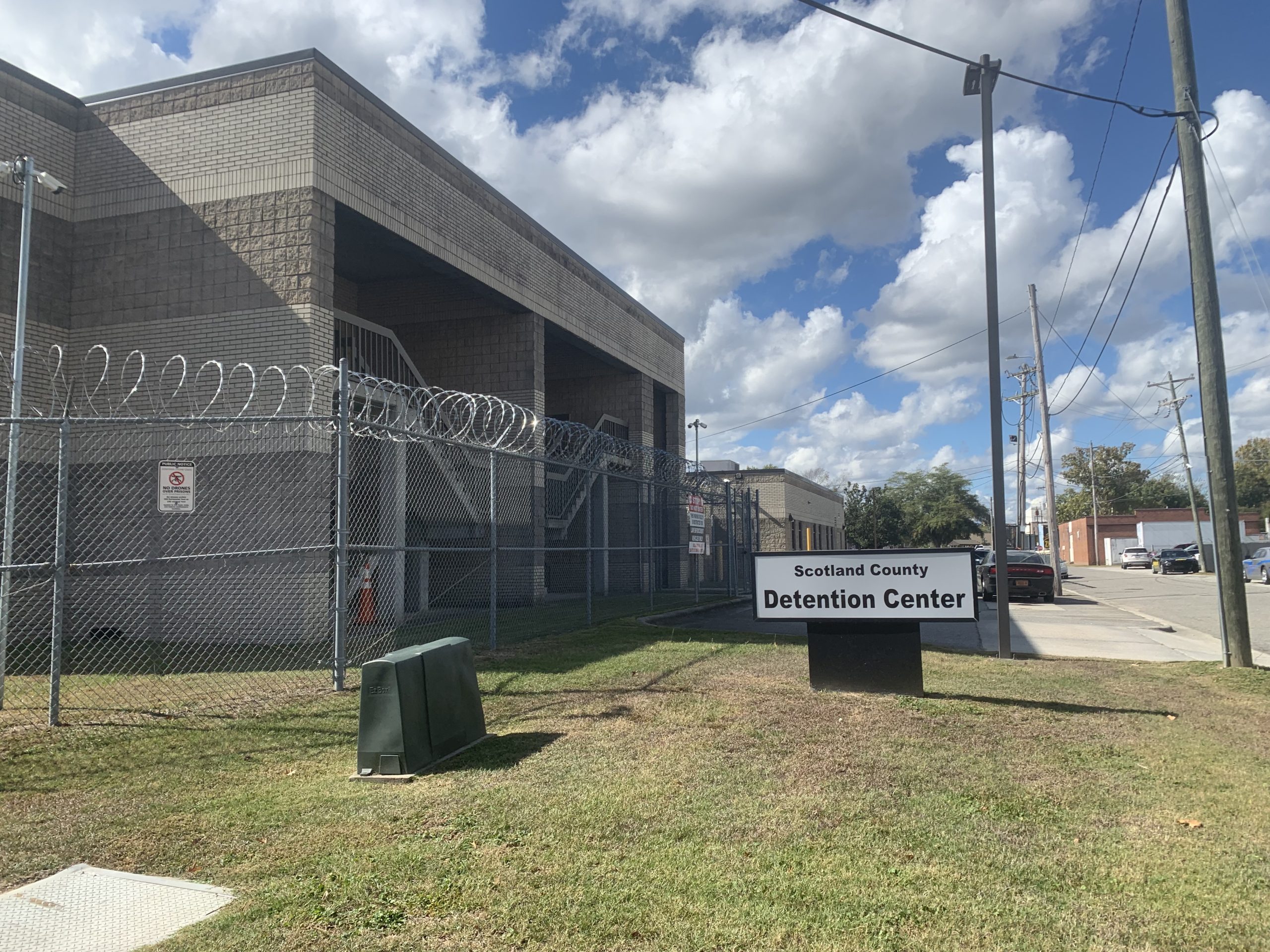
A gray brick building surrounded by barbed wire with a sign for Scotland County Detention Center
The Scotland County Detention Center in Laurinburg is facing overcrowding.

The Robeson County Detention Center is also overflowing. Designed to hold 410 people, Maj. Ryan Howard told NC Health News on June 1 that the jail had a population of 508 people. Another 53 people connected to the county were being housed elsewhere — either in one of five other county jails with space or in state prison as a “safekeeper,” which is someone who poses security risks or requires a higher level of medical or mental health care than counties can manage. 

Robeson’s jail has exceeded its capacity every month since at least January 2024, making it one of the most chronically overcrowded facilities in the state based on NC Health News’ analysis of jail population data. So far this year, the jail has operated at an average of 123 percent of capacity.

“It’s an everyday struggle,” Howard told NC Health News. 

Overcrowding isn’t new for many jails. After jail populations dropped during the COVID-19 pandemic, they have steadily rebounded in many counties — stretching facilities to and beyond capacity. 

“The numbers just keep going up,” Hunt said about Scotland’s jail population.

Scope of overcrowding

North Carolina has 98 jails operating across 93 counties, with a combined bed capacity of 25,838. Thousands of people cycle in and out of them every year; some spend only a few days behind bars, while others remain for weeks, months or even years either awaiting trial or serving sentences.

The N.C. Department of Health and Human Services maintains an annual confinement report that tracks each jail’s average monthly population, providing a snapshot of capacity and overcrowding. 

During the first half of 2026, 26 jails averaged more than 100 percent of capacity. If the pace continues the rest of the year, that will be more than the 16 jails in 2025 that averaged over 100 percent occupancy.

Of the one in three jails that have exceeded capacity in at least one month in 2026, many weathered consecutive months of overcrowding. Nineteen jails have exceeded capacity every month in 2026 for which state data is available.

Some jails exceeded capacity by only a handful of people, while others housed dozens more than they were designed to hold. 

Luke Woollard, an attorney at Disability Rights North Carolina, has tracked jail populations and inspections for years to ensure that people with disabilities in local jails receive proper treatment. He told NC Health News he’s increasingly concerned about overcrowding across the state, particularly with an uptick in jail deaths.

Woollard said a jail doesn’t have to exceed its capacity to become unsafe. Another important factor to consider is staffing — a number not captured in the statewide confinement report.

“If you have a serious staffing shortage, you might as well be overcrowded,” Woollard said. “Yes, to some degree, it is what the building can hold, but before that becomes a problem I would say really when we talk overcrowding, what we’re talking about is safe staffing ratios.”

As an example, Woollard pointed to the June 29 takeover at Bertie-Martin Regional Jail in Windsor, where some of the 88 incarcerated people overpowered the three correctional officers on duty — a typical level of staffing for the jail — and took two of them hostage. The jail has a capacity of 90, and state data shows that the average monthly population has remained below capacity this year. Based on the population count alone, Woollard said the jail wouldn’t necessarily raise concern.

Woollard said North Carolina has no statewide mandatory staffing ratio for jails, allowing staffing levels to vary across the state, particularly as some counties struggle to recruit and retain correctional officers.

Vivian Saunders, chairwoman of the Bertie-Martin Regional Jail Commission, told Bertie County commissioners on July 13 that three to four correctional officers working per shift to supervise the population is normal. She said the jail currently employs just 14 correctional officers. 

Scotland County is also facing staffing pressures. Sheriff Ralph Kersey addressed his county commissioners on July 6, after the Bertie hostage situation, about his jail’s dire staffing levels and the risks posed to staff and those in custody. He said his jail houses more than double the number at Bertie-Martin Regional Jail — yet has the same number of officers working each shift. 

“Right now with four officers with 189 inmates, that’s 62 inmates assigned to one person,” Kersey told commissioners.

He said just 20 people are assigned to work at the jail and that he needs at least six more officers to keep up with the larger population.  

Increases in jail populations can quickly strain detention centers. Every incarcerated person requires food, clothing, a bed and medical care — costs that add up quickly and demand more staff to handle daily operations, security rounds and services.

“I’m just asking for some help,” Kersey said. “We’ve got serious problems over there,” he added, referring to staffing gaps, along with the aging infrastructure of the jail.

A portable bed platform used to sleep the excess of people in county jail
Portable bed platforms provided to the overflow of people housed at Mecklenburg's jail in uptown Charlotte.

McFadden, Mecklenburg County’s sheriff, is upfront that overcrowding deteriorates the conditions at his jail — with people sleeping atop portable platforms on the floor and dozens more people sharing the limited number of showers, toilets and phones. He also said tensions can flare with more people in tight quarters, placing staff and those in custody at greater risk.

“No time is really a good time to come to jail, but if you come to jail now, you will be here for a while, and accommodations will be even worse,” McFadden said. 

While overcrowding is a common problem, not all North Carolina jails are over capacity. Twenty-two jails operated at less than 70 percent of their capacity, on average, during the first half of 2026. 

Lauren Earnhardt, executive vice president of the North Carolina Sheriffs’ Association, said some counties — which are responsible for funding jails — have prepared better than others by investing more in their jail space and staffing than others. 

Iryna’s Law takes effect

Sheriffs and jail administrators say one of the newest factors adding pressure on jail capacity is Iryna’s Law, which took effect in December in response to the fatal stabbing of 23-year-old Iryna Zarutska in August on the Charlotte light rail. The man accused in her killing has a criminal history and severe mental health challenges, prompting lawmakers to scrutinize gaps in North Carolina’s mental health and criminal justice systems. 

The law requires magistrates and judges to apply stricter criteria when weighing release decisions for people charged with violent offenses, or for those who have been charged with a Class 1 or higher misdemeanor three times within the past decade. Class 1 misdemeanors include offenses such as breaking and entering, drug paraphernalia possession and criminal trespassing. 

The law also eliminates the option for defendants to be released on a “written promise to appear” and requires judicial officials to make written explanations for release decisions.

Supporters, including the North Carolina Sheriffs’ Association, argued that the law would improve public safety by keeping more people in jail and breaking the cycle of quick releases followed by repeat offenses. At the same time, several sheriffs warned it could further strain already crowded detention centers.

Mecklenburg’s sheriff was among those who voiced concerns. Since the law took effect, McFadden said his jail population has swiftly climbed to the highest level he’s seen since he became sheriff in 2018. The jail’s population has climbed from its monthly average of 1,530 in November 2025 — the month before the law took effect — to an average of 2,016 by June 2026, an increase of about 32 percent.

McFadden acknowledged the law isn’t solely responsible for driving the growth. 
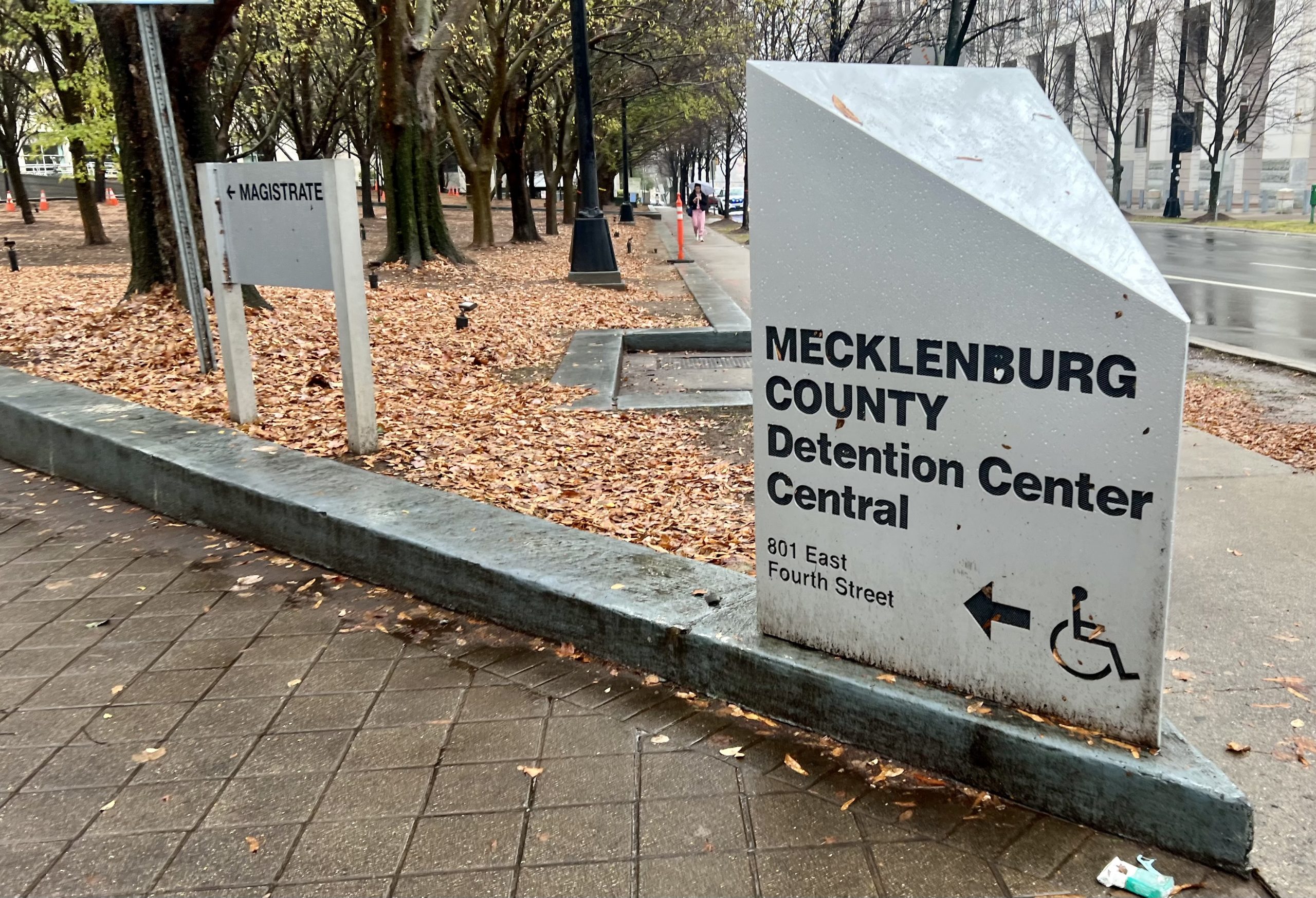
A sign reading
A sign leading to Detention Center Central in Charlotte. The jail is among the many jails facing overcrowding in North Carolina.

Six months ago, McFadden said, several housing pods sat empty. Now, not only is every pod full, many are overcrowded. 

In response to what he describes as “unprecedented overcrowding,” McFadden announced in May his plans to reopen Mecklenburg County Jail North — a 721-bed facility — later this summer. Jail North most recently housed juveniles before closing in 2022 because of staffing shortages at the county’s adult jail.

Wake County Sheriff Willie Rowe said in a statement to NC Health News his jail population has also risen, exceeding the combined capacity of the county’s two detention facilities, which have 1,574 beds. 

In June, the monthly average population was 1,736 — 162 people above capacity. He attributes some of the population growth to more people being held in custody without bond due to stricter pretrial release rules under Iryna’s Law. On Dec. 1, when the law took effect, about 198 people were held in custody without bond. By April 21, that number had more than doubled to 424.

Earnhardt of the North Carolina Sheriffs’ Association said the direct impact of Iryna’s Law on statewide jail populations is still not clear, and she’s not aware of any formal analysis that has examined it.

Prison logjam

Another factor sheriffs and jail administrators frequently say contributes to capacity strains is the backlog of people who have been sentenced but continue occupying space in county jails while waiting to be transferred to the state prison system to serve their time. As of June 23, 1,432 people were in county jails because the N.C. Department of Adult Correction didn’t have room and/or staffing for them at state prisons. 

Chronic correctional officer staff shortages have prevented the prison system from taking more people into its custody, Keith Acree, the department’s communications director, said in a statement to NC Health News. 

He said staffing shortages have forced the department to close 4,686 beds at 17 prisons — about 12 percent of the prison system’s total capacity.

Meanwhile, Acree said an increasing number of convictions from the courts have slowly grown the backlog over the past year.

Acree said that people that have been on the backlog longest are generally transferred to prison first, though the department works with sheriffs’ offices “when special issues arise.”

As of June 23, the department also housed 199 “safekeepers” for county jails, and Acree said those placements occupy beds that would otherwise be available to admit people into prison.

Expanding jail capacity

For overcrowded jails, there’s not much relief in sight. 

“Sheriffs are in a tough spot,” Earnhardt said. “The sheriff cannot decline to take people into the jail. They’re required by law to accept whatever comes to the jail door that cannot make bond, and so the options for a sheriff are pretty limited … They’re really at the mercy of the court system, and that’s a really hard place to be.”

In Robeson County, Howard, the jail administrator, reviews the population daily, looking to identify anyone who can safely be moved. He works with the county district attorney to see if there are options to speed up court proceedings, consider electronic monitoring or adjust bonds for people who don’t pose a danger.

Those efforts can temporarily ease crowding, Howard said, but relief is often short-lived as new people enter the jail.

Howard and other jail administrators facing overcrowding also lean on other counties with available bed space to house some of their detainees. But finding space at other jails has become increasingly difficult as more facilities fill up and have less space to offer. When beds are available, they may be hours away, creating transportation challenges for court appearances. 

As overcrowding persists, many counties are building — or planning to build — larger jails. 

In the past two years, Haywood, Randolph and Wayne counties have completed jail expansion projects, while eight other counties have construction projects underway, according to DHHS data provided to NC Health News.

More counties are discussing construction projects, including Scotland, Richmond, Union and Carteret.

Kersey, Scotland County’s sheriff, pleaded with county commissioners earlier this month to move forward with expanding the jail — whether through renovations and an addition, an entirely new jail, or even a regional jail shared with Richmond County. While Kersey is leaving office in five months after not seeking a fourth term, he said the issues with the jail aren’t going away. 

Woollard cautioned that building larger jails isn’t a “silver bullet” for capacity challenges.

“You can’t just build your way out of it,” Woollard said. “You also need staffing for these facilities, and these facilities take a while to build.… You might end up just transplanting your staffing issues from one facility to another.”

Beyond building new, larger jails, Woollard said counties should look at upstream strategies to reduce the number of people entering jail in the first place, including non-police behavioral health response teams and diversion programs for low-level offenses.

Sheriffs and jail administrators frequently note that many people entering jail have mental health and substance use disorders that contribute to their involvement in the criminal justice system.

“There are inadequate resources for mental health and substance abuse treatment, and so a lot of those people end up in jail who shouldn’t be there in the first place,” Earnhardt said. “If there was better mental health treatment in our state or a place that those people could go and be secured, then the jails also would not be as crowded.”

This article first appeared on North Carolina Health News and is republished here under a Creative Commons Attribution-NoDerivatives 4.0 International License.

Monday, June 8, 2026

Fact Check: President Trump Did NOT win the 2024 Election by a Landslide


Donald Trump continues to revise history to his favor.  The truth of the matter is that he did not win the 2024 electon by a landslide.  In fact according to an article that was published on January 20, 2025 by The Hill, these are the facts:

"President Donald Trump and his allies have called his win a “landslide” and “blowout.” From their telling, Trump’s “sweeping,” “historic” victory has given MAGA a “powerful mandate” to govern.

Some commentators have pushed back, noting, for instance, that Trump’s 1.5 percent popular vote victory is one of the smallest ever — just a fraction of Lyndon B. Johnson’s 22.6 percent landslide win in 1964. Trump failed to secure a majority of the popular vote, at 49.7 percent, unlike George W. Bush in 2004 (50.3 percent), Barack Obama in 2008 and 2012 (52.9 percent and 51 percent) and Joe Biden in 2020 (51.3 percent). And while Trump won all seven swing states, his 312 electoral votes were only a handful more than Biden’s 306 in 2020 — and far less than Obama’s 365 in 2008 or Ronald Reagan’s 525 in 1984."

Read the article in its entirety here:

https://thehill.com/opinion/campaign/5094602-a-landslide-just-0-15-percent-of-all-voters-determined-trumps-2024-victory/

Monday, October 6, 2025

North Carolina Lawmakers Are Misguided in Response to Iryna Zarutska’s Murder


Let me be clear from the start, I, like most humane, sane, and kind people, sorrowed over the killing of 23-year-old Iryna Zarutska on a Charlotte metro train. No one should experience such a tragic and horrible death. By all accounts, Iryna should be here today. She should be living her best life in a country that she fled to from her war-torn home of Ukraine. She should be enjoying the magic of being young, beautiful, and full of hope in a country that offers an abundance of opportunities to succeed and live out her dreams.

However, I can’t think of Iryna without also thinking sadly about 34-year-old Decarlos Brown Jr., the person charged with her fatal stabbing. His story is also tragic, and his family also deserves public sympathy and our prayers. Many lawmakers including Governor Josh Stein, President Trump and VP Vance as well as members of the NC General Assembly are using this tragic case as a political battle ax and an opportunity to demonstrate a “tough on crime” posture. However, the fact of the matter is, rarely has vigilante justice cloaked as sensible public policy ever worked the way lawmakers think it will.

The reality is that Decarlos Brown’s case points more to colossal systems failures that are not uncommon; rarely do any of our public judicial, social services, and mental health systems act or respond to the needs of people in crisis quickly. The hard truth is that Decarlos Brown is a tragic case study for what happens when our mental health, legal, and social services systems fail people with serious mental illness.  Let me be clear, people with SMI are more likely to be victims of crime than they are to be perpetrators of violent crime. In fact, people with SMI are more likely to be a harm or danger to themselves than to others. Data from credible sources including the American Psychological Association report that persons with SMI account for about four percent of all violent crime in the US.

According to multiple reports, Decarlos’s family sought help for him and unfortunately, they faced what many families face—slow responses, closed doors, and woefully inadequate action. Governor Stein and the NCGA appear to be misguided about what is needed the most to mitigate and reduce the risk of another Iryna story from happening again. News flash, it is not stricter or draconian criminal laws or heavy-handed law enforcement responses. I think many sociologists and criminologists as well as mental health professionals would agree—what we need is more investments in building up our community mental health services including evidence-based critical time interventions; and more financial investments into a shamefully underfunded public mental health, substance use, and IDD services system.  (Ironically our public MHDDSUS system is at risk of failing more people as we face the very real threat of drastic and deep Medicaid cuts.) What we need are more investments into creating a stronger labor force to  meet the needs of people with serious mental health conditions including more trauma informed licensed clinicians; what we need is more funding to support housing and employment needs of persons in MH and substance use recovery.  What we DON’T need is continued criminalization of people with mental health and substance use conditions. What we DON’T need is a general assembly and Governor who is short-sighted, reactionary, and blind when it comes to meeting the social drivers of health outcome needs including healthcare coverage, safe and affordable housing supports, and food security. And what we definitely DON’T need is to begin militarizing our local police but instead endorsing and expanding the community policing model that encourages law enforcement to know the people they are assigned to protect and serve. 

The reality is, Iryana should be alive today and Decarlos should have gotten the help he needed long before this tragedy happened. And our lawmakers should be leading us through this valley to higher ground not simply enacting laws that essentially keep us in the same place and fail to address the root causes of crime and violence.


Tuesday, September 16, 2025

Americans Are in A Dangerous War Whether We Realize It or Not


I have been directly and tangentially  involved in politics for a long time now, at least 30 years and if you include the time I ran for class president at Chapel Hill High School back in the 80s, well then you do the math. Inspired in large part by the profiles of courage of fierce Black women in North Carolina including my grand and great grandmothers; Godmother, the late Senator Jeanne Lucas (the first Black woman to serve in the North Carolina Senate); and Congresswoman Eva Clayton (the first Black woman from NC to serve in Congress), I also ran in the May 2018 Democratic primary for Congress in North Carolina’s 4th Congressional District, challenging a 30-year incumbent.  I was the first Black, woman, and Chapel Hill High School graduate to run for a congressional seat in North Carolina’s 4th Congressional District on the Democratic ticket. Needless to say, I fully understand that political campaigns are very much like a war: candidates representing two different parties go into battle against each other with one sole mission in mind—to take out the other candidate and win. And just like in a war, all kinds of weapons and ammunition are used to defeat the opponent and ensure victory. While most political campaigns are relatively amicable, at least in public, behind the scenes all kinds of chicanery and even malicious tactics are devised. Some of the tactics that campaigns employ in order to stack the odds of winning in their favor border on, if not cross the lines of, being menacing, unethical or even criminal, from stealing or removing campaign signs, attempting to besmirch the opponent’s character for example digging up dirt on the opponent uncovering shameful things they may have done in their adolescent or reckless young adult years to acts that spillover to harming others beyond the opponent including voter suppression.  The list of what can and has been done by political operatives to shore up a win is endless and there is no low to how far some will go to make sure a political candidate ends up the victor.

 In addition to the political war tactics, and just like in military battles, there are also the spoils of war. The things that the victor wins or gains. In military battles these spoils can include any and everything from land acquisition, territory occupation, economic gains, to even world domination and unbridled global power and influence. In United States, the past presidential election is a great case to make my point. I won’t go down the stolen-election conspiracy dark hole but I will highlight the extraordinary amounts of money that was poured into both former Vice President Kamala Harris and former  and now president Donald Trump’s campaigns in what is commonly referred to as a “war chest.” An estimated $1 Billion was raised by the Harris campaign compared to an estimated $3.8 Billion raised by the Trump campaign. Interestingly President Trump’s FEC filings are listed under a PAC titled, “Never Surrender, Inc.,” which supports the main point I wish to make. One of the primary objectives when embattled in war is exactly that--never surrender, and for some, that means by any means necessary—win by hook or crook as my grandmother would say. I will leave it up to the reader to decide if the winner of the 2024 general election—President Trump won by hook or crook. Either way you assess it, Donald Trump won and became the POTUS and by my assessment, the win was through tactical maneuvers that had no boundaries or rules of engagement. Political wars tend to be void of rules of engagement tantamount to  International Humanitarian Law or Geneva Treaty, which limits the harm done to people who are not directly participating in warfare including principles that distinguish between combatants and civilians, ensuring military actions are not excessive in relation to the military advantage gained—a term referred to as proportionality, or acts to prohibit inhumane treatment or unnecessary suffering.  

Aside from the spoils of the political war that Trump won including the outrageous amounts of wealth his family is amassing, what we are seeing a president who is not governing but whose mind is programmed to continue the war until all vestiges of our Democratic Republic are decimated.  He is driven by one guiding principle—never surrender, which is similar to the lesson taught to him by his once revered mentor Roy Cohn--never admit defeat and deny, deny, deny. Never surrender power, not even to the supposedly co-equal branches of government—the judicial and legislative branches. Never surrender control not even to the comrades who we will call the Republican party leadership. Never surrender or claim defeat of any kind even through legal sanctions or litigation. And once in power, never give it up.

We are in a perpetual war in the United States whether we believe it or not. It is a war not just against immigrants, people of color, the poor including in rural America which is the bastion of MAGA supporters—but it is also a war with an objective now to change the landscape and infrastructure of our Democratic Republic into one that he has made clear he prefers and aspires to rule—an oligarchy modeled after Russia.  My fear is that far too many people who many consider authorities on world affairs are underestimating the stronghold that Putin and Russia’s governing structure has on the mind of President of Trump. We have reduced the actions of the president to basic disdain of others who are not white, male, and uber wealthy. While that kind of ideology may be baked in, it is not what is driving his bulldozing and excavating of America’s longstanding cornerstone institutions. It is his insatiable fixation on becoming and modeling Putin’s regime. He truly does not intend on ever surrendering his power and supreme authority over America and as the late Dr. Maya Angelou said, when people SHOW you who they are, believe them the first time. My fear is despite what President Trump is showing us; there are far too many people who are refusing to believe what they are actually seeing an instead are getting distracted by flashing lights and bouncing balls that are merely a mirage.

Saturday, October 19, 2024

Ta-Nehisi Coates Is Not A Lone Voice Crying in the Wilderness But A Lion with a Pen


There is an African proverb that says: “Until the lions have their own historians the tale of the hunt will always glorify the hunter.” I was galled and annoyed (to put it mildly) witnessing the September 30th interview on CBS Mornings between acclaimed author Ta-Nehisi Coates and Tony Dokoupil. Dokoupil’s unprofessional questions and biased comments attempting to discredit Coates’ scholarship, CBS later acknowledged “fell short of editorial standards.”  

The truth of the matter is that the conclusions that Coates emphasized in his new book, The Message, and the assertions that many others have made about the Israeli and Palestinian perpetual war is far from slipshod, naïve, or parochial. All one must do is to examine past critical analyses and deconstructions of the Israeli and Palestinian conflict and they will find that Coates’ assessment is not an anomaly. In fact, public criticism by Black academicians, sociopolitical observers and activists calling out the Israeli government (not its people) for acting as an imperialist hegemon date back to the 1950s. In the 1960s and 70s famous Black activists like Martin Luther King Jr., Malcolm X, Jesse Jackson, and Muhammed Ali issued public pronouncements on the Arab Israeli conflict. In 1966, SNCC expanded its publicly denouncement of the Vietnam War to the Israeli attacks against the Palestinian people, which drew widespread condemnation and accusations of anti-Semitism. In 1967, SNCC used a summer issue of its newsletter to offer a searing indictment of Isreal’s violent Zionist conquest.

Black people in general have often viewed the Jews in Israel and the Palestinians in Gaza as special and unique cases with histories similar to our own in America. Many draw parallels of the violence inflicted upon innocent Palestinian people  today to the attempts to extinguish the Native Americans, the abhorrent acts of police brutality against Blacks, and the manifold forms of structural inequity and racism that have kept African Americans (in the collective) chained to its origin in America as second-class citizens.  Many Black defenders of the Palestinians’ right to exist under a two-state solution in Gaza did not come to that conclusion without first supporting and empathizing with the plight of the Jews. For many, their affinity for Isreal changed after the 1967 war when Israel defeated its Arab neighbors--Egypt, Jordan, and Syria to occupy the Sinai Peninsula, Gaza, and the West Bank, as well as the Golan Heights. It was then that many Black people would begin to question Isreal as a sympathetic and empathetic friend of Arab and African people and begin to see the Israeli political class as a byproduct of fascist and imperialists compulsions.

Russell Rickford wrote in his article “To Build a New World” (2019):

Israel itself was a product of Western imperialism, having sprung from the British Mandate for Palestine. Seeing Israel as a liberatory enterprise meant accepting the erasure of displaced Palestinians while reifying settler-colonial myths about the cultivation of a modern civilization on a barren frontier. Yet in the aftermath of the Holocaust, few Western observers heeded or even grasped these realities.

African Americans largely identify as Christian.  It is the Christian belief that the Israelites are God’s “chosen people” combined with recognizing that as descendants of slaves brought to and who built America that we know all too well what it feels like to be treated inhumanely and  perceived as the “other” in the only land we know. We view the Jewish holocaust experience and the genocide that is happening now to the Palestinian people at the hands of Isreal through the lens of America’s holocaust –slavery. However, it has been the tyrannical and inhumane decisions made by the elite political class in Isreal (not the Jewish people in the collective) with support of course of the American political elite, which have caused many Black people to side with the Palestinians and condemn Isreal.

From the past to the present, it is a shared anti-imperialist imperative that bind Black/African American to Palestine. The tie that binds us is a simple and larger world view shared by many comrades in the struggle against hegemonic sociopolitical systems built and sustained by race and class hierarchies, white and European supremacy, and colonizer ways of thinking, believing, acting, and being. It is not about hating Jewish people or being antisemitic like so many spinmeisters cleverly and deceitfully propagate. It is about doing what the sacred scriptures in both the Torah and Bible demand: “to do justice and love mercy” and to know that God has no respect of cultures or people. Our destinies and our histories are intricately intertwined. In the words of Dr. Martin Luther King Jr., “We are all caught in an inescapable network of mutuality, tied into a single garment of destiny. Whatever affects one directly, affects all indirectly.”

Wednesday, December 27, 2023

Racism Linked to Poor Brain Health among Black People and other Historically Marginalized Populations


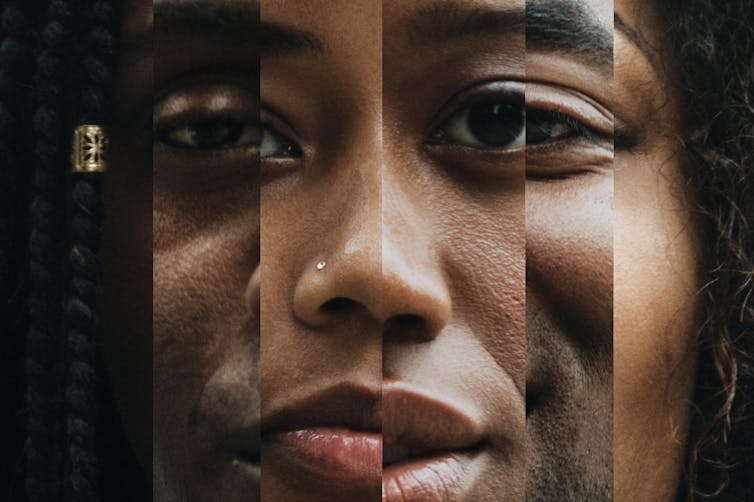
Racism produces subtle brain changes that lead to increased disease risk in Black populations

Coping with everyday affronts comes at a cost and requires a certain level of emotional suppression. RyanJLane/E+ via Getty Images
Negar Fani, Emory University and Nathaniel Harnett, Harvard Medical School

The U.S. is in the midst of a racial reckoning. The COVID-19 pandemic, which took a particularly heavy toll on Black communities, turned a harsh spotlight on long-standing health disparities that the public could no longer overlook.

Although the health disparities for Black communities have been well known to researchers for decades, the pandemic put real names and faces to these numbers. Compared with white people, Black people are at much greater risk for developing a range of health problems, including heart disease, diabetes and dementia. For example, Black people are twice as likely as white people to develop Alzheimer’s disease.

A vast and growing body of research shows that racism contributes to systems that promote health inequities. Most recently, our team has also learned that racism directly contributes to these inequities on a neurobiological level.

We are clinical neuroscientists who study the multifaceted ways in which racism affects how our brains develop and function. We use brain imaging to study how trauma such as sexual assault or racial discrimination can cause stress that leads to mental health disorders like depression and post-traumatic stress disorder, or PTSD.

We have studied trauma in the context of a study known as the Grady Trauma Project, which has been running for nearly 20 years. This study is largely focused on the trauma and stress of Black people in the metropolitan Atlanta, Georgia, community.

How discrimination alters the brain

Racial discrimination is commonly experienced through subtle indignities: a woman clutching her purse as a Black man walks by on the sidewalk, a shopkeeper keeping close watch on a Black woman shopping in a clothing store, a comment about a Black employee being a “diversity hire.” These slights are often referred to as microaggressions.

Decades of research has shown that the everyday burden of these race-related threats, slights and exclusions in day-to-day life translates into a real increase in disease risk. But researchers are only beginning to understand how these forms of discrimination affect a person’s biology and overall health.

Our team’s research shows that the everyday burden of racism affects the function and structure of the brain. In turn, these changes play a major role in risk for health problems.

For instance, our studies show that racial discrimination increases the activity of brain regions, such as the prefrontal cortex, that are involved in regulating emotions.

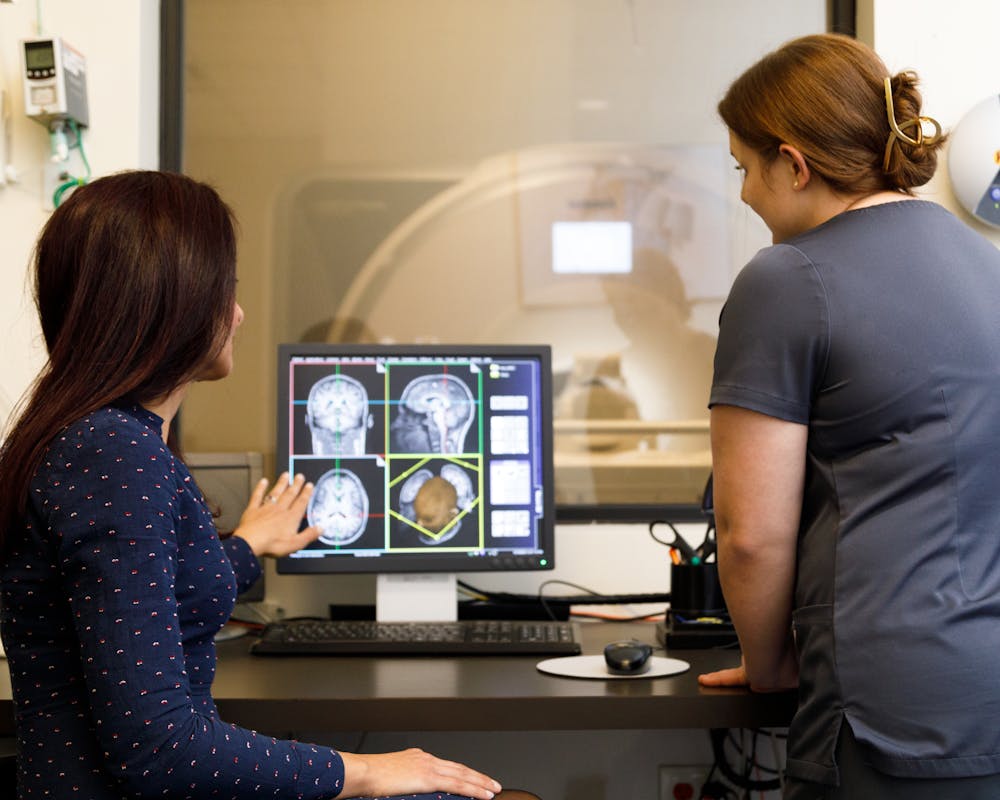
Scientist and technologist view brain images.
Negar Fani and a team member view brain images. Patrick Heagney

This increased activity in prefrontal brain regions occurs because responding to these types of affronts requires high-effort coping strategies, such as suppressing emotions. People who have experienced more racial discrimination also show more activation in brain regions that enable them to inhibit and suppress anger, shock or sadness so that they can curate a socially acceptable response.

A cost for overcompensating

Despite the fact that high-energy coping allows people to manage a constant barrage of threats, this comes at a cost.

The more brain energy you use to suppress, control or manage your feelings, the more energy you take away from the rest of the body. Over time, and without prolonged periods of rest, relief and restoration, this can contribute to other problems, a process that public health researcher Arline Geronimus termed “weathering.” Having these brain regions in continual overdrive is linked with accelerated biological aging, which can create vulnerability for health problems and early death.

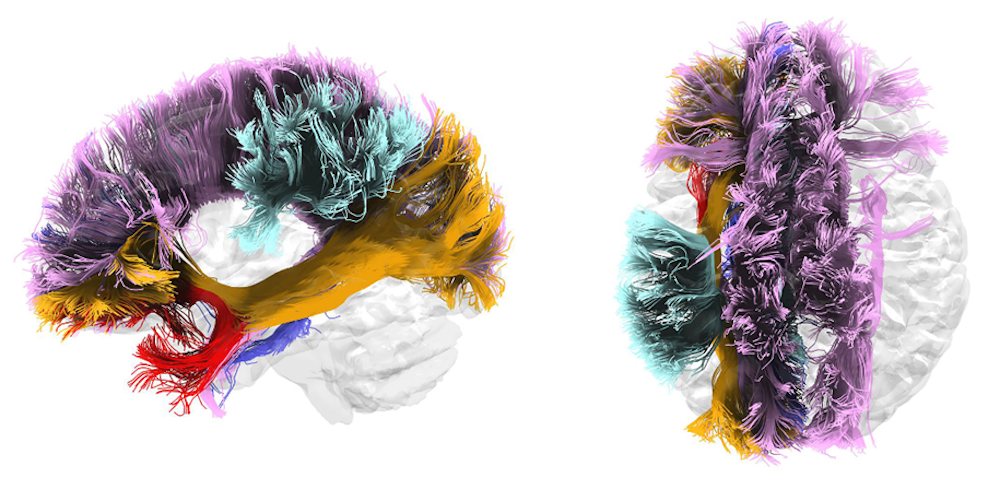
In our research, we have found that this weathering process is evident in the gradual degradation of brain structure, particularly in the heavily myelinated axons of the brain, known as “white matter,” which serve as the brain’s information highways.

Computer-generated image of white matter tracts in the brain.
Rendering of white matter fibers − shown in color − throughout the brain. Negar Fani

Myelin is a protective sheath around nerve fibers that allows for improved communication between brain cells. Similar to highways for vehicles, without sufficient maintenance of the myelin, degradation will occur.

Erosion in these brain pathways can affect self-regulation, making a person more vulnerable to developing unhealthy coping strategies for stress, such as emotional eating or substance use. These behaviors, in turn, can increase one’s risk for a wide variety of health problems.

These racism-related changes in the brain, and their direct effects on coping, may help to explain why Black people are twice as likely to develop brain health problems such as Alzheimer’s disease compared with white people.

Recognizing racial gaslighting

In our view, what makes racism particularly insidious and pernicious to the health of Black people is the societal invalidation that accompanies it. This makes racial trauma effectively invisible. Racism, whether it originates from people or from institutional systems, is often rationalized, excused or dismissed.

Such invalidation leads those who experience racism to second-guess themselves: “Am I just being too sensitive?” People who have the temerity to report racist events are often ridiculed or met with skepticism. This extends to academic spheres as well.

This continual questioning and doubting of the circumstances around racist experiences, or racial gaslighting, may be part of what depletes the brain of its resources, causing the weathering that ultimately increases vulnerability to brain health problems.

Interrupting this cycle requires that people learn to identify their biases toward people of color and people in marginalized groups more generally, and to understand how those biases may lead to discriminatory words and behavior. We believe that by finding their blind spots, people can see ways in which their actions and behaviors could be viewed as hurtful, exclusionary or offensive. Through recognition of these experiences as racist, people can become allies rather than skeptics.

Institutions can help to create a culture of healing, validation and support for people of color. A validating, supportive institutional culture may help people of color normalize their reactions to these stressors, in addition to the connection – and restoration – they may find within their communities.The Conversation

Negar Fani, Associate Professor of Psychiatry and Neuroscience, Emory University and Nathaniel Harnett, Assistant Professor of Psychiatry, Harvard Medical School

This article is republished from The Conversation under a Creative Commons license. Read the original article.

Monday, December 18, 2023

Former NC Senatorial Candidate Cherie Beasley's Authenticity No Longer Compromised following Campaigning as a Black Woman


Originally published by The 19th

CAMBRIDGE, MASSACHUSETTS — The first thing I noticed was Cheri Beasley’s hair. When she greeted me on the Harvard University campus, it was in twists, set in a half-up, half down style that fell over the front of her tweed-style blue blazer.

The look was a departure from the straightened hair she wore during her 2022 U.S. Senate campaign in North Carolina. When I commented on the change, she smiled.

“It was really after the election that I thought I would try something new,” Beasley told me. “It's been refreshing. It's been renewing. It's been liberating.”

For Black women, hair has always been political. Natural Black styles in the form of braids, twists, locs and afros have long been disparaged as less professional than sleek, straight hair. In an interview during her book tour last year, former First Lady Michelle Obama said she made a conscious choice to keep her hair straightened while she was in the White House; the country, she said, was “not ready” for her natural Black hair. 

Beasley’s twists, and her role as a resident fellow with Harvard Kennedy School’s Institute of Politics this semester, signal a new stage for her political engagement after more than two decades as a judge and her Senate run. 

A portrait of Harvard Kennedy School's Fall 2023 Resident Fellows, including Cheri Beasley, is displayed on a television screen at the Institute of Politics, in Cambridge, Massachusetts.
A portrait of Harvard Kennedy School’s Fall 2023 Resident Fellows is displayed on a television screen at the Institute of Politics, in Cambridge, Massachusetts in November 2023. (Vanessa Leroy for The 19th)

The liberation she described showed in her relaxed body language and candid words as well. In October 2022, she told me she refused to “get caught up in the pettiness of partisan politics.” Now she’s ready to offer more frank assessments of the challenges and the promise of electoral politics for Black women. 

It was clear from our conversation that Beasley saw herself as much more than another candidate who lost an election. She was the first Black woman nominated by a major party for a U.S. Senate seat in North Carolina. She ran a competitive campaign as a Democrat. To her that is significant, not just personally, but for Black women candidates in the South and Black women generally. Organizers and academics who spoke with The 19th agreed. As advocates calling for more Black women in the U.S. Senate look to 2024 elections, Beasley’s campaign can serve as a powerful playbook.

“We really shouldn't look at it as a loss for the effort of Black women running and seeking higher office,” Beasley said. “I was a credible candidate, and every time we run and fight hard, we are moving the ball forward. That makes it easier for the next African-American woman to run and hopefully win.”


Last November, Beasley lost her bid for the open Senate seat in North Carolina to Republican Ted Budd by three points. Her loss, as well as that of former U.S. Rep. Val Demings, who challenged incumbent Republican Sen. Marco Rubio in Florida, temporarily dashed the hopes of people pushing for a Black woman to take a Senate seat. 

The 100-member Senate did not have a single Black woman for more than two years after Vice President Kamala Harris resigned to join the White House. That wouldn’t change until October, when Laphonza Butler became the only Black woman in the Senate. She was appointed to fill late Sen. Dianne Feinstein’s California seat.

Only three Black women in U.S. history have been U.S. senators. There has never been a Black woman governor. Securing these high-profile positions is a particular challenge for candidates who are often shut out of fundraising, networking and other opportunities more open to candidates who are White and men. 

The key concern for any political candidate is whether they can win. For Black women that pressure is more acute, academics and organizers told The 19th. They’re often at a financial disadvantage in big races, with less ability to self-fund and greater challenges raising money from donors. The Senate in particular has become a “millionaire’s club,” requiring spending an average of $16 million for a race, said Katherine Tate, a professor of political science at Brown University.

Cheri Beasley campaigns in Smithfield, North Carolina in October 2022.
Cheri Beasley campaigns in Smithfield, North Carolina in October 2022. (Melissa Sue Gerrits/Getty Images)

“Often these senators are independently wealthy, and so this prevents a lot of Black women from being considered suitable to run for these offices, because they just don't have that kind of wealth,” she said. “That’s a challenge when you want to integrate the highest levels of government."

Misconceptions about Black women also shape voters’ ability to connect with these candidates. They are often viewed as singularly focused on championing issues that affect Black people as opposed to the broader electorate, said Nadia Brown, a professor of government and director of women’s and gender studies at Georgetown University.

“That’s the rub: How can Black women appeal to these larger audiences outside of majority-minority districts?” Brown said. “What my research shows is that voters think about Black women as these kind of niche candidates or politicians who are great with dealing with issues that are at the nexus of race and gender, but they're not good on traditional ‘masculine’ issues like taxes or war, and things that are going on in the news right now.”

In North Carolina, Beasley had to deal with those factors, as well as the realities of running as a Democrat in a Republican-leaning state. She was tasked with not only energizing the urban Democratic base, but also connecting with rural, independent and conservative voters.

It’s a particularly challenging state, said Diane Robertson, a Democratic Party precinct chair for North Carrboro, North Carolina, who was a member of Beasley’s “kitchen cabinet” — the unofficial group of advisers for her Senate campaign.

People cheer for Cheri Beasley as she walks in the North Carolina Central University Homecoming Parade.
People cheer for Cheri Beasley as she walks in the North Carolina Central University Homecoming Parade in November 2022 in Durham, North Carolina. (Allison Joyce/Getty Images)

While Black women tend to perform better in more diverse urban areas with a Democratic base, North Carolina has the second-largest rural population after Texas — 3.4 million people. Last year, unaffiliated voters became the largest voting bloc in the state.

This combination of factors means that candidates have to put in more work to travel to each of the state’s 100 counties, 80 of which are rural, to reach as many voters as possible, Robertson said. They also need to raise a lot of money for media exposure.

Black women have the additional burden of pitching themselves as someone who can represent a majority-White population that has few interactions, if any, with Black woman candidates.

Beasley took that challenge head on.

“I feel good about the fact that we had a lot of folks who shared our beliefs and understood that I was in this race to really fight hard for all of North Carolina, and for this country,” Beasley said. “It's an honor that people were gracious enough to support me; we received contributions from all 100 counties in the state. But of course, the loss was disappointing.”


Beasley adopted what one state senator referred to last year as a “North Carolina flavor” campaign.

She spent time in rural areas of the state and made an intentional effort to push for issues she believed rose above partisan identity, such as lowering health care costs, supporting small and rural towns, and expanding benefits for families, such as the child tax credit and paid family leave. Ultimately she outraised Budd by more than $20 million — a notable feat for a Black woman Democrat in a state that has only ever elected two women total (one of them a Democrat) as U.S. senators.

“Cheri, in my opinion, completely did her part,” said Stefanie Brown James, co-founder of The Collective PAC, which supports progressive Black political candidates. “What fell short was everybody else's contributions, and the Democratic infrastructure and ecosystem to be able to go toe-to-toe with the outside spending for her opponent and against her on the airwaves.”

People take photos with Senate candidate Cheri Beasley at the Cumberland County Cookout and Canvass Launch event.
People take photos with Senate candidate Cheri Beasley at the Cumberland County Cookout and Canvass Launch event in Fayetteville, North Carolina in November 2022. (Allison Joyce/Getty Images)

National Democrats have been criticized by organizers and some election watchers for not giving Beasley’s race more attention and money. Beasley echoed this criticism. Local, state and national Democrats urged her to run, she said; national Democrats said they would invest in her race. But then their interest went elsewhere. 

“National Democrats' unwillingness to invest was a huge disappointment and, in significant part, led to my loss,” Beasley said in a follow-up email. “Promises to invest in my race were made by national Democrats which never materialized.”

As Beasley’s team moved forward, the messaging against her at times relied on racial biases or stereotypes.

Beasley recalled one political ad that questioned her record as a family court judge early in her career, implying that her decisions on the court were harmful to children.

Another ad targeted her time as chief justice of the North Carolina Supreme Court. The ad, titled "Failed Our Children," claimed that Beasley either released or threw out indictments for three people accused of sexual crimes involving children. North Carolina television stations ultimately pulled the ad after a Democrat-aligned legal group wrote letters to the stations calling the ad misleading.

“These groups that spend millions of dollars targeting me and other African-American women know exactly what they're doing when they do that,” Beasley said. “It's cruel and it's unfair to voters.”

Linking Black women to criminals — even child abusers — is a strategy used in other instances. In her confirmation hearings last year, now-Justice Ketanji Brown Jackson faced questions from Republican senators who repeated misleading claims about her sentencing record in several child sexual abuse cases.

“I think this portrayal is particularly hurtful because it goes back to the stereotypic trope about Black women not being good mothers,” Brown said. “They are seen as unfit to mother, they are seen as not nurturing, not caring.”

Beasley is aware of the collective hardships Black women candidates face — from the lack of robust financial investment to blatant racism. These difficulties keep some Black women from running for office altogether. Brown James and Brown both said there is little evidence that support for Black women candidates from the political establishment has improved since Beasley’s loss.

Cheri Beasley leaves her office at Harvard Kennedy School.
Cheri Beasley leaves her office at Harvard Kennedy School in Cambridge, Massachusetts in November 2023. (Vanessa Leroy for The 19th)

Despite the continued challenges, Beasley said she sees the positives of her campaign. She has demonstrated that Black women can be competitive candidates who can raise large amounts of money and connect with a wide sector of a state population. 

Other shifts in the political landscape are paving a way for more Black women in political positions. Over the last several years a growing number of Black women have run for elected office around the country. In certain areas, such as the suburbs, demographic changes in the electorate have fostered more voters who trust Black women candidates and their capabilities, Tate of Brown University said. Black women overall are proving more that they not only have what it takes to win over voters from different backgrounds but can gain the resources to run high-caliber campaigns. 

While Butler said she will not run to hold the seat she was appointed to, it’s likely the next Senate will have at least one Black woman. Rep. Lisa Blunt Rochester of Delaware is viewed as a favorite to win, and in Maryland, Prince George’s County Executive Angela Alsobrooks has endorsements from a number of high-ranking Democrats in the blue state. 

Beasley said it’s exciting to see the line-up of Black women for 2024, and she is hopeful there will continue to be advancements in this representation.

“It's monumental that I was the first African-American woman to be the Democratic nominee for the U.S. Senate in North Carolina,” Beasley said. “But I also know that it's important for us to figure out how to win these races. There's a wealth of opportunity.”

Saturday, January 21, 2023

Allegations of Plagiarism Are Not New Weapons Used to Besmirch the Reputation of Black Leaders

I, like many of my friends and peers who are Black women with PhDs from traditional programs at predominantly white institutions (often referred to as PWIs), simply shook our heads in disgust and called or texted each other with comments like, “here we go again,” or “I am not surprised” when the “news” story broke about an anonymous person who instigated an investigation by a News & Observer reporter into Chapel Hill—Carrboro City Schools’ superintendent Dr. Nyah Hamlett’s dissertation. For many of us who matriculated through a traditional program at a PWI (not through an online university or program but who actually had to show up every day in the minority as "Black faces in white spaces") it conjured up feelings and experiences that many shared even though we may have gone through different programs at different schools. Experiences that include having your intellectual prowess always under microscopic scrutiny, never being given the benefit of the doubt when mistakes or errors are unintentionally made, finding mentally healthy ways to repel the routine microagressions, or having your writing ability criticized to humiliating degrees when your white peers are praised for their writing ability that would never stand up as superior to yours by peer reviewers or others outside of the program that you are enrolled.

 The reality is that if a sample of dissertations were pulled you would probably find some errors in citations or references that could be argued is an example of plagiarism in a large percentage of those sampled. However, in most of those cases, I would argue that it wasn’t willful intent but sloppiness or careless editing by not only the student but his or her advisor and dissertation committee members. Earning a PhD involves many more people other than the student. Therefore, calling into question the integrity of a dissertation also calls into question the integrity of the student, their committee, advisor, program, and school.

In addition to feeling the insult and hurt on a personal level that Dr. Hamlett no doubt felt, in preparation to speak at the recent Chapel Hill—Carrboro City Schools Board of Education meeting, which was three days after Martin Luther King, Jr.’s birthday holiday, I couldn’t help but to think about the controversy that surrounded a similar investigation into Dr. King’s dissertation. On October 11, 1991, the New York Times ran an AP article reporting the following: 

  “A committee of scholars appointed by Boston University concluded today that the Rev. Martin Luther King Jr. plagiarized passages in his dissertation for a doctoral degree at the university 36 years ago. ’There is no question,’ the committee said in a report to the university's provost, ‘but that Dr. King plagiarized in the dissertation by appropriating material from sources not explicitly credited in notes, or mistakenly credited, or credited generally and at some distance in the text from a close paraphrase or verbatim quotation.’ Despite its finding, the committee said that ‘no thought should be given to the revocation of Dr. King's doctoral degree,’ an action that the panel said would serve no purpose.” 

While I don’t endorse plagiarism and do believe that all scholars should demonstrate the highest of integrity especially those who are directly influencing or impacting the impressions of children, I also believe that what should be considered in these cases is the intention of the author combined with the degree to which suspicion of plagiarism is found not just in a couple of sentences but throughout the body of work by the author. People make mistakes, especially in haste or when fatigued by an arduous and grueling process, which I think many people with earned PhD’s would agree characterizes the process of matriculating through a PhD program especially by the time you make it to and through the dissertation process. There is nothing in Dr. Hamlett’s track record as an academician and administrator that suggests she is anything other than an intelligent, honest, and adept leader with integrity and an unwavering commitment to and compassion for all children. 

I am a native of Chapel Hill and went from elementary school, junior high and high school in the district on to graduate from undergrad at UNC Chapel Hill. It sickens me that in a school district like Chapel Hill—Carrboro, which has failed to deliver on its promise of ensuring a high quality education for all children and not just those from affluent backgrounds that this allegation of plagiarism is being used as a weapon to besmirch the reputation of and destroy faith a superintendent who by all measures has what it takes to help the district rise to higher ground. While the district is recognized as one of the top in the nation, behind that shining recognition is a dark reality. For decades it has failed to ensure that Black and in some cases Hispanic/Latino, refugee, and poor kids have the same educational outcomes as white and affluent kids in the district. Those students who are thriving in the district are those who have all the means to do so no matter what school district they are in. And, those students who have the most have parents who often fight the hardest and demand the loudest for more when the primary focus of the community at large should be on how the district can truly become a shining example for the nation by demonstrating its ability to produce children with little resources to excel academically and move from the bottom to the top.

 I don’t know who the anonymous person was who instigated the investigation. I would recommend however that he or she use their influence and power to work with Dr. Hamlett, and the district’s school board and administration to help find solutions to more weightier matters like as Delores Bailey, Chapel Hill resident, former parent and Executive Director of Empowerment, Inc. pointed out in her remarks to the school board---homeless families with children in Chapel Hill and Carrboro who are sleeping in cars and yet getting up every morning and going to school, or, I add the children whose parents work multiple jobs and don’t have the time to invest like other parents into helping their children achieve academically but who are trusting that the resources are available in the schools they are attending, or the children who are trying to navigate through multiple adverse childhood experiences including parent drug use, violence, and trauma. That to me would be a far better investment of time and resources and would yield much greater, nobler, and lasting returns. It would also model the type of behavior that would inspire young people in the district to become upstanding, contributing, compassionate, and positive global world citizens, not bullies, meanspirited, and divisive scandalmongers.

Thursday, September 22, 2022

The Middle Class and Poor Can't Catch a Break When It Comes to Paying for Health Care

The $18,000 Breast Biopsy: When Having Insurance Costs You a Bundle

When Dani Yuengling felt a lump in her right breast last summer, she tried to ignore it.

She was 35, the same age her mother had been when she received a breast cancer diagnosis in 1997. The disease eventually killed Yuengling’s mom in 2017.

“It was the hardest experience, seeing her suffer,” said Yuengling, who lives in Conway, South Carolina.

After a mammogram confirmed the lump needed further investigation, Yuengling scheduled a breast biopsy for Valentine’s Day this year at Grand Strand Medical Center in Myrtle Beach.

Among many concerns she had ahead of that appointment — the first being a potential cancer diagnosis — Yuengling needed to know how much the biopsy would cost. She has a $6,000 annual deductible — the amount her health plan requires she pay before its contribution kicks in — and she wasn’t close to hitting that. Whatever the procedure cost, Yuengling knew she’d be on the hook for most of it.

But the hospital wouldn’t give her a price. She was told her providers wouldn’t know what type of biopsy needle they needed until the procedure was underway and that would impact the price.

The hospital’s online “Patient Payment Estimator” showed Yuengling an uninsured patient would owe about $1,400 for the procedure.

“That’s fine. No big deal,” she thought to herself, confident it would be cheaper for her because she did have insurance. A Google search indicated it could be closer to $3,000, but Yuengling thought that price seemed reasonable, too. She wasn’t fretting too much about money as she underwent the procedure.

It soon brought the good news that she didn’t have cancer.

Then the bill came.

The Patient: Dani Yuengling, now 36, who is covered by Cigna through her employer, a human resources contractor for the Mayo Clinic.

Medical Service: An ultrasound-guided breast biopsy.

Service Provider: Grand Strand Medical Center, a 403-bed, for-profit hospital in Myrtle Beach, South Carolina. It is one of 182 hospitals owned by Nashville-based HCA Healthcare, which generated $58.7 billion in revenue last year.

Total Bill: $17,979 for the procedure, including lab work, pharmacy charges, and sterile supplies. Cigna’s in-network negotiated rate was $8,424.14, of which the insurance company paid the hospital $3,254.47. Yuengling was billed $5,169.67, the balance of her deductible.

What Gives: It’s not uncommon for uninsured patients — or any patient willing to pay a cash price — to be charged far less for a procedure than patients with health insurance. For the nearly 30% of American workers with high-deductible plans, like Yuengling, that means using insurance can lead to a far bigger expense than if they had been uninsured or just pulled out a credit card to pay in advance.

Ge Bai, an associate professor at Johns Hopkins Bloomberg School of Public Health, recently published research on this topic and said hospitals in the U.S. often set their cash prices lower than the prices they charge to treat commercially insured patients.

“We can very confidently say this is very common,” said Bai, who advised that all patients, regardless of their insurance status, inquire about the cash price before undergoing a procedure. “It should be a norm.”

Grand Strand charged Yuengling’s insurance an extraordinarily high price for her procedure. By comparison, according to the federal government’s website, Medicare patients who need an ultrasound-guided biopsy similar to the one Yuengling received would pay only about $300 — their required 20% coinsurance for outpatient care. Medicare would pay the hospital the remainder of the bill, about $1,200. The hospital expected more than five times the Medicare price from Yuengling and her insurer.

Patients in Conway with private health insurance who are treated at other hospitals also typically are charged less than what Yuengling paid for the same procedure — on average about $3,500, according to Fair Health Consumer, an organization that analyzes health insurance claims.

And uninsured patients who pay cash prices and need an ultrasound-guided breast biopsy at the nearby Conway Medical Center are likely to owe even less — about $2,100, according to Allyson Floyd, a spokesperson for the hospital.

Meanwhile, Grand Strand Medical Center spokesperson Caroline Preusser blamed “a glitch” involving the hospital’s online calculator for the inaccurate information Yuengling received and said the correct estimate for the cash price for a breast biopsy at the hospital is between $8,000 and $11,500 “depending on the exact procedure and equipment used.”

The hospital removed certain procedures from the payment estimator until they can be corrected, Preusser wrote. She did not say how long that would take.

Resolution: Yuengling tried disputing the charges with the hospital. She called the billing department and was offered a 36% discount, lowering the amount she needed to pay to $3,306.29. Grand Strand Medical Center allows patients to set up payment plans, but Yuengling decided to charge the full amount to a credit card because she wanted the whole thing to go away.

“I could not sleep. It was driving me crazy. I was having migraines. I was sick to my stomach,” she said. “I hate having debt. I didn’t want to think about it. Obviously, that didn’t work because I’m still thinking about it.”

She said she requested on multiple occasions to speak to the hospital’s patient advocate and was eventually connected with an outside company, Parallon, which conducted an audit of her bill. She eventually received a letter dated May 26 from the hospital’s Revenue Integrity Department. It stated: “After a review of the charges in question and your medical record, the following was identified; The charges on your account were appropriate.”

“I don’t know why I actually expected a different outcome,” she said.

The hospital has requested that Yuengling return for a follow-up appointment related to the biopsy. She has refused.

Harlow Sumerford, a spokesperson for HCA Healthcare, told KHN in an email that the hospital system apologizes for any confusion caused by the payment estimator “and we are working to fix the issue.”

The Takeaway: With a family history of breast cancer, Yuengling was right to follow up with her doctor after feeling a lump. After failing to get a clear answer on her costs from Grand Strand Medical Center, she could have taken an additional step to explore what other hospitals in the area charge. Although her physician referred her to Grand Strand, she was not obligated to use that hospital. She could have saved a significant amount of money by opting to undergo the procedure elsewhere.

Related Links

Furthermore, patients like Yuengling who have a high-deductible insurance plan should consider paying cash prices for certain procedures and not involving their insurance company at all.

Jacqueline Fox, a health care attorney and a professor at the University of South Carolina School of Law, said she isn’t aware of any law that would prohibit a patient from doing that. After all, she pointed out, patients with health insurance pay cash prices for prescription medications all the time. It stands to reason they could do the same for medical procedures.

But some facilities make this difficult. Grand Strand Medical Center, for example, offers “self-pay” patients an “uninsured discount,” but that discount is limited to people who have “no third party payer source of payment or do not qualify for Medicaid, Charity or any other discount program the facility offers,” according to the hospital’s website. Only patients confirmed to have no health insurance are offered information about the discount.

In some cases, paying a cash price for a procedure might not make financial sense in the long run because none of it would be applied toward the deductible. Patients might save money on one procedure but end up paying their full deductible if unexpected medical expenses mount later during the calendar year.

Insured patients should reach out to their health plan for a good-faith estimate before a procedure. Under the No Surprises Act, health plans are supposed to give members an idea of their total out-of-pocket costs upon request. Ask for an “Advanced Explanation of Benefits,” said Sabrina Corlette, a research professor at the Georgetown University McCourt School of Public Policy, though she points out this part of the law isn’t being enforced yet.

The No Surprises Act also allows patients to file complaints with the federal government regarding their medical bills — whether or not they carry health insurance.

Yuengling filed her complaint in June.

Stephanie O’Neill contributed the audio portrait with this article.

Bill of the Month is a crowdsourced investigation by KHN and NPR that dissects and explains medical bills. Do you have an interesting medical bill you want to share with us? Tell us about it!

KHN (Kaiser Health News) is a national newsroom that produces in-depth journalism about health issues. Together with Policy Analysis and Polling, KHN is one of the three major operating programs at KFF (Kaiser Family Foundation). KFF is an endowed nonprofit organization providing information on health issues to the nation.

Subscribe to KHN's free Morning Briefing.